Yoav Lerner
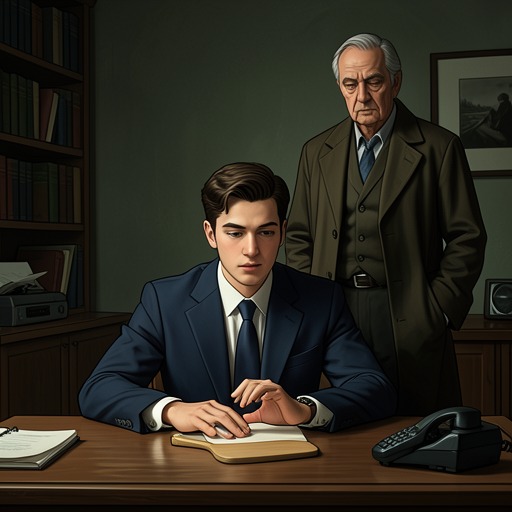
Here There Is No WhyYoav Lerner is the only son of Chaim and Zehava Lerner, and his hidden military history becomes one of the decisive forces in Judah Loeb’s investigation into Chaim’s death. At first he exists mainly as an anxious absence: his parents argue whenever Lebanon or Sabra and Shatila is mentioned, while they know only that he is stationed somewhere in the region and cannot say exactly what he is doing. When his actions are finally disclosed, Yoav is revealed not simply as a soldier in danger but as a man accused of shooting two ten-year-old boys. The revelation fractures the family’s public language of patriotism, humanitarianism, and sacrifice, while making Yoav a living counterpoint to the family’s attempts to explain suicide and violence.
Identity and Background
Yoav grows up in an English-speaking household, which accounts for his fluency in English, and is presented in a family photograph as a boy with wild dark-brown hair, thick-lensed glasses, and a nervous smile. The image places him between a younger Chaim and Zehava on a beach, preserving an earlier vision of familial happiness that later scenes cannot sustain. His parents describe him as their son, but their reactions to his military service show that he is also the point at which national conflict enters the home.
As an adult, Yoav serves sixteen years in the Intelligence Branch of the Israel Defense Forces before becoming chief software engineer at IsraTech, Israel’s leading high-tech firm, headquartered in Rishon Letziyon with offices in Boston, Houston, and Johannesburg. He is reluctant to discuss his military service, and the narrative emphasizes that only fragments of it become available. This combination of technical authority, guarded speech, and suppressed military knowledge makes him difficult to read: he belongs simultaneously to the worlds of intelligence, high technology, family loyalty, and wartime violence.
Military Service and the Lebanon Incident
During the period Judah first encounters the Lerners, Yoav is stationed in Lebanon. Chaim says that he handles communication for his unit and is technically in the rear, but remains part of the battle. Zehava cannot separate the word Lebanon from thoughts of her son, and the family’s Shabbat dinner becomes charged with fear, exhaustion, anger, and political argument. The parents’ contradictory positions are partly theatrical: Chaim defends the current right-wing government while Zehava attacks it, although neither truly believes the claims being made. Their quarrel is a displaced argument about what Yoav’s service means and what it may have done to him.
Charlie later tells Judah that Yoav’s case has become well known among soldiers who serve in Lebanon. According to the report, Yoav took his gun and shot at two ten-year-old children in Southern Lebanon, within the Israeli zone near the border. Charlie says that Yoav was a poor shot but nevertheless hit both boys. The account leaves open whether the children were armed, carrying bombs, hiding pistols, or throwing rocks; more importantly, it states that Yoav did not claim any such justification. He reportedly said that he did not remember the incident, a defense that Charlie suspects may have been supplied by a lawyer, while also allowing that Yoav may simply have snapped.
The consequences are uncertain even within the story. Yoav is believed to be in a military hospital in Haifa, perhaps in a psychiatric ward, while the army considers whether to prosecute him, treat him, or release him. His condition is therefore suspended between criminal responsibility and medical explanation. The uncertainty does not lessen the violence. Instead, it makes the case more disturbing, because neither the family nor the military can offer a stable category in which to place him.
Family, Love, and Marriage
Yoav’s relationship with Michal began in childhood. They attended the same middle school and high school, belonged to the same scouts youth group, were the same age, and lived across the street from each other. They became high-school sweethearts and later serious young adult lovers. Their history explains why Yoav’s name produces such visible tension in Michal, even while she is involved with Judah.
The relationship breaks when Yoav applies for officer training. Michal experiences the decision as a commitment to greater danger and deeper involvement in the Lebanon conflict, a war she despises. They quarrel by telephone, and she hangs up. When Yoav does not call back the next day, Michal assumes the relationship has ended and begins seeing Judah. Her account makes the new relationship neither wholly false nor wholly free: she is happy with Judah, but that happiness is mixed with guilt and with the unfinished emotional force of Yoav.
Zehava, who has always treated Michal as a daughter, repeatedly asks her to visit Yoav in the military hospital after learning about the shooting. Michal initially refuses, considering the relationship over, but eventually relents. Her visit becomes a turning point. She tells Judah that she still loves him, while the story preserves the ambiguity of whether that love is an active choice, an old attachment, or both. Soon afterward, Yoav becomes engaged to Michal, and Chaim and Zehava announce the news to Judah with joy, apparently assuming that he may already know because of his friendship with Michal.
The engagement forces Judah to leave Israel. Chaim suggests that Judah may have reached the end of his adventure and perhaps should return home. Judah interprets the advice uncertainly, wondering whether Chaim is offering wisdom or quietly removing a nuisance whose work has become entangled with the family’s crisis. Three days before his flight, Judah visits Michal to say goodbye. Instead of discussing the separation, she draws him into her apartment and has intercourse with him for the first time. The act is significant because Michal had previously reserved sex for marriage and because Judah remembers its exact date and time; years later, that precise memory becomes consequential. Yoav’s marriage to Michal thus contains a concealed prior intimacy with Judah, adding betrayal and memory to the already unstable family structure.
Public Hostility and Private Ceremony
When Judah and Hannah later return to Zehava’s home, Yoav studies Judah’s movements as though he were a security guard examining a suspected suicide bomber. He reacts irritably to Hannah’s speech, and his hostility becomes explicit when she discusses suicide bombings, including the different motivations associated with depression, trauma, hopelessness, and chronic pain. Because Hannah has mentioned her mother’s suicide, Yoav hears her general discussion as a comparison between his father and a suicide bomber.
Yoav responds with quiet fury, insisting that Chaim was a humanitarian and challenging Hannah for comparing him with men who had murdered innocent Israelis and children. Zehava rebukes him for attacking a fifteen-year-old, but he redirects the confrontation toward Judah, demanding to know why he has come and whether he intends to destroy his father’s reputation, his mother’s reputation, or both while using Hannah as a shield. His anger shows how completely he identifies Chaim’s reputation with his own family’s survival. The accusation also reveals that Yoav understands Judah’s investigation not as neutral reporting but as an assault on the dead and on those left behind.
Yet Yoav is not represented only through rage. At a later Shabbat dinner, after Chaim’s death, he sits at the head of Zehava’s table and lifts the silver Kiddush cup. Chaim and Zehava had been secular Jews, but Chaim had traditionally led the Friday-night rituals as the man of the house. With Chaim absent, the task passes to Yoav. He chants the blessing in a confident, unexpectedly pleasing tenor, and Michal watches him with a warmth and relaxation that surprise Judah. The ceremony does not erase their history or the violence surrounding him, but it shows Yoav occupying the place left vacant by his father, carrying family continuity through a ritual that he may not otherwise embody.
Later Life and Narrative Significance
Yoav’s later career as a software engineer contrasts sharply with the military incident without resolving it. He moves from sixteen years in military intelligence to a senior position in Israel’s high-tech sector, suggesting a passage from the machinery of war into the machinery of technological modernity. His professional success does not produce confession or public reconciliation. In an interview included in Judah’s book, he condemns journalists for getting facts wrong, turning inaccuracies into elaborate theories, and writing fiction while claiming to report reality. He distinguishes political bias from what he regards as journalistic stupidity, even while acknowledging that he shares the view that Israel has often become the aggressor.
That interview makes Yoav a critic of the very process that has made him a subject. He resists being converted into an explanatory case, whether the explanation is psychological breakdown, wartime pressure, family trauma, or political ideology. His refusal also complicates Judah’s authority. The journalist wants a coherent account of Chaim’s death and of the family’s secrets, whereas Yoav insists that factual errors precede every theory. His voice therefore functions as both testimony and obstruction: it demands accuracy while withholding the complete history that would allow accuracy to become understanding.
Yoav later writes to Hannah in imperfect English after learning through an internet search about Mary Loeb’s suicide. He distinguishes his own conduct from Mary’s death with brutal clarity: he says that he was a murderer, or tried to murder, whereas Mary was ill and afraid. He argues that she did not try to kill anyone else and that Hannah should not judge her mother. The letter places Yoav within the book’s larger chain of inherited suffering. He recognizes some of Mary’s fear and lostness, yet insists that the moral difference between self-destruction and attempted murder cannot be dissolved by the general language of suicide.
His life ultimately resists the heroic pattern of confession, purification, and return. Yoav survives the Lebanon incident, becomes a successful engineer, marries Michal, performs the family’s ritual after Chaim’s death, and addresses Hannah across the distance created by violence and secrecy. But no single revelation integrates these roles. He remains at once son, husband, soldier, suspected killer, intelligence veteran, engineer, and reluctant witness. Through him, the book asks how a family can preserve love without denying harm, and how a society can classify violence when military service, trauma, punishment, treatment, and silence overlap. Yoav’s decisive significance lies in that unresolved collision: his face is repeatedly encountered by others, but never fully assimilated into a reassuring explanation.